

The Complete Guide to AI Agent Implementation: From Concept to Deployment

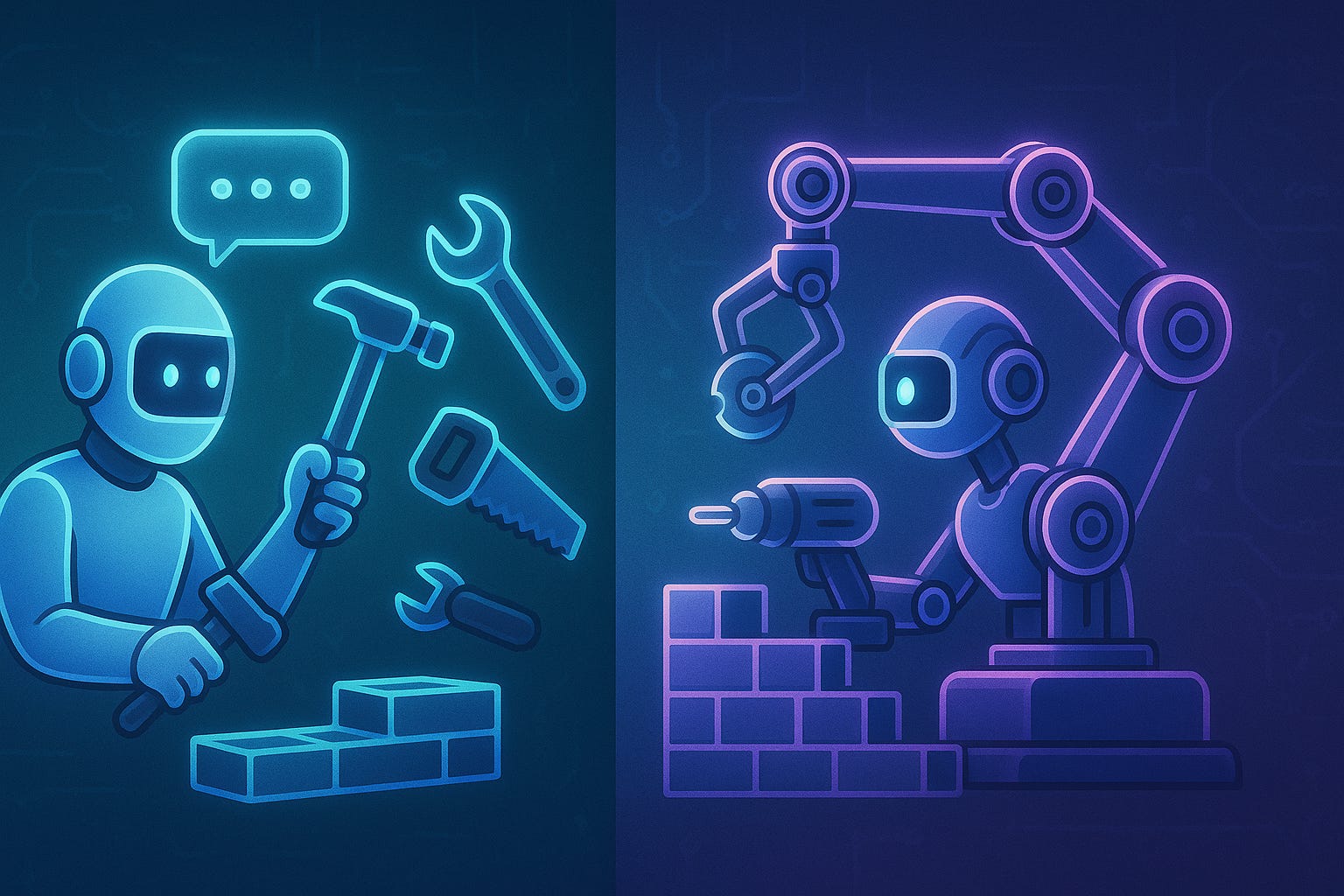
In today's rapidly evolving AI landscape, executives and product leaders face a critical question with significant implications for their organisation's productivity and competitive advantage: When should you use simple AI tools versus investing in full-fledged AI agents?
This distinction isn't merely semantic—it represents fundamentally different approaches to workflow automation that can dramatically impact efficiency, resource allocation, and strategic outcomes. Over the past year, I've seen dozens of companies navigate this decision, and the patterns that emerge offer valuable insights for any organisation looking to maximise their AI investment.
Understanding the Fundamental Distinction: AI Tools vs. AI Agents
Before diving into implementation strategies, let's establish a clear definition of the difference between AI tools and agents through a concrete example familiar to product teams:
The AI Tool Approach (Question-Answer Model)
When using an AI tool like ChatGPT, the interaction follows a predictable pattern:
A product manager inputs a request: "I need to write a PRD for a new mobile payment feature. Here's my outline and key requirements..."
The AI generates a comprehensive PRD matching the specified format and requirements
The product manager reviews the output, makes edits, and decides what to do next
If they want to create user stories from this PRD, they must initiate another interaction
To create wireframes, they must initiate yet another interaction
For each new task or system interaction, the human remains the central coordinator
This interaction model is essentially a sophisticated question-answer exchange. The human remains firmly in control, deciding what to do with each output and manually coordinating between steps, systems, and processes.
The AI Agent Approach (Autonomous Decision-Making)
In contrast, when using an AI agent, the interaction looks dramatically different:
The product manager activates a Product Development Agent with: "I need to launch a mobile payment feature"
The agent independently:
Accesses the company's documentation system to understand current capabilities and standards
Drafts a comprehensive PRD based on company templates and historical documents
Automatically breaks this down into epics and user stories
Creates these tickets directly in JIRA via API integration
Generates initial wireframes for key screens
Schedules review meetings with relevant stakeholders
Notifies the product manager when human input is required
The agent independently determines the next steps, accesses necessary systems, makes contextual decisions about what information is needed, and completes multiple actions across various platforms—all while requiring minimal human intervention.
The Decision Framework: Choosing the Right Approach
From my experience, I've developed a clear framework for determining which approach delivers the best results for specific scenarios:
Use AI Tools When:
The workflow is still evolving or being defined
When your process isn't yet standardised, starting with AI tools gives you the flexibility to experiment and iterate. An example I saw used AI tools to help with regulatory compliance checks, allowing them to refine their approach through several iterations before codifying the workflow into an agent.
Human judgment is critical between steps
Some workflows require careful human evaluation at multiple points. A marketing agency found that while AI could generate initial campaign concepts, human creative directors needed to review and redirect these concepts before proceeding to execution planning.
You need transparency in decision-making
When understanding the rationale behind each step is essential, the question-answer model provides greater visibility. A healthcare provider using AI for treatment recommendation summaries maintained a tool-based approach specifically because clinicians needed to see exactly how each conclusion was reached.
The process involves sensitive decisions with significant consequences
High-stakes choices often benefit from human oversight. An investment firm implemented AI tools rather than agents for portfolio recommendation analysis specifically to ensure human portfolio managers reviewed each recommendation before any action was taken.
You're just beginning your AI implementation journey
Starting with tools builds organisational confidence and competence. A manufacturing company began with simple AI tools for maintenance documentation before gradually expanding to more sophisticated implementations.
Use AI Agents When:
The workflow is well-established and repeated frequently
When patterns are clearly defined and repetitive, agents shine. A legal department that processed hundreds of similar contracts monthly implemented an agent that reduced processing time by 80% by automating the entire review workflow.
Decision rules are complex but definable
When workflows involve numerous decision points that follow consistent logic, agents can manage this complexity effectively. A customer service department replaced an unwieldy 200-point manual decision tree with an agent that dynamically evaluated customer situations and determined appropriate responses.
Multiple systems need to be coordinated
When tasks span across different platforms and applications, agents eliminate manual handoffs. A marketing team implemented an agent that coordinated content creation, approval workflows, and publication across five different systems—eliminating dozens of manual steps.
Significant time is spent on predictable coordination activities
When valuable human time is consumed by routine coordination, agents create immediate ROI. A product team implemented an agent that automated sprint planning coordination, saving each team member approximately 5 hours per week.
Speed of execution is paramount
When rapid response creates competitive advantage, agents deliver significant value. A trading firm implemented agents for market monitoring that could instantly generate analysis reports when specific conditions were detected, cutting response time from hours to minutes.
The Implementation Journey: From Tools to Agents
The most successful AI implementations I've observed follow a consistent pattern—starting with AI tools and evolving toward agents as workflows stabilise and patterns emerge.
This progression typically follows four phases:
Phase 1: Exploration (2-4 weeks)
The exploration phase focuses on identifying high-potential use cases and establishing baseline capabilities:
Activity: Use basic AI tools to understand capabilities and identify value
Focus: Quick experiments across multiple potential use cases
Metrics: Subjective feedback and qualitative improvements
Tools: Commercial AI platforms with minimal customisation
Governance: Limited, primarily focused on data security
Case Study: Financial Services Regulatory Reporting
A financial services company began their journey by experimenting with using ChatGPT to summarise regulatory updates. The compliance team would input regulatory notices and ask for summaries of key points, changes, and implementation timelines. This simple application immediately saved the team hours of reading time and helped them identify high-priority updates that required attention.
During this phase, they discovered that the quality of summaries varied significantly based on how questions were phrased. This led them to document effective prompting techniques that would later become crucial in developing standardised approaches.
Phase 2: Standardisation (4-8 weeks)
Once promising use cases are identified, the standardisation phase creates consistency and reliability:
Activity: Develop consistent prompting techniques and document workflows
Focus: Creating repeatability and establishing quality baselines
Metrics: Consistency of outputs and time savings
Tools: Customised prompting libraries and evaluation frameworks
Governance: Template development and usage guidelines
Case Study: Marketing Content Production
A marketing agency moved from exploration to standardisation by documenting exactly how their team used AI for different content types. They created:
A library of effective prompts for different content formats (blog posts, social media, emails)
Guidelines for how to properly provide context and brand voice information
Quality evaluation checklists to ensure AI-assisted content met standards
A workflow document showing when human intervention was required
This standardisation increased consistency across their team and reduced the time spent "figuring out how to ask" by 60%. It also created the foundation for more advanced implementation by clearly documenting decision points and system interactions.
Phase 3: Integration (6-12 weeks)
The integration phase connects AI capabilities with existing systems to reduce manual handoffs:
Activity: Connect AI tools to existing systems via APIs
Focus: Reducing friction in workflows and eliminating manual steps
Metrics: Process completion time and error reduction
Tools: API integration platforms and workflow automation tools
Governance: Access controls and system interaction policies
Case Study: Customer Support Escalation
A SaaS company integrated their AI tool with their customer support platform, creating a semi-automated workflow where:
Customer inquiries were automatically analysed and categorised
The AI system generated recommended responses based on similar past issues
These recommendations were provided to support agents through their existing interface
Agent selections and modifications were captured to improve future recommendations
This integration reduced average response time by 45% while maintaining high customer satisfaction. It also created data on which decisions required human judgment most frequently—valuable information for the final phase.
Phase 4: Automation (12+ weeks)
The automation phase transforms integrated tools into true agents that operate autonomously:
Activity: Building autonomous agents with defined parameters
Focus: End-to-end process automation with appropriate human oversight
Metrics: Fully automated process completion and exception rates
Tools: Agent orchestration platforms and custom development
Governance: Comprehensive frameworks for agent operation and oversight
Case Study: Legal Contract Processing
A legal department evolved their contract review process through all four phases, culminating in a true agent implementation that:
Automatically processed incoming contracts uploaded to their document system
Extracted and analysed key terms against the company's predetermined requirements
Flagged non-standard clauses with specific annotations explaining concerns
Generated summary briefs for legal review
Routed contracts to appropriate attorneys based on content and workload
Tracked outstanding issues until resolution
This agent reduced contract processing time from an average of 7 days to less than 24 hours, while actually improving accuracy by ensuring no clauses were overlooked.
Common Pitfalls and How to Avoid Them
Recently looking at these examples, I’ve seen recurring pitfalls that organisations encounter when building AI agents:
Pitfall 1: Attempting to Build Agents Too Early
The most common mistake is jumping directly to agent implementation before establishing clear workflows and understanding decision points. A technology company spent six months building a sophisticated agent for their product development process, only to abandon it because it didn't align with how their teams actually worked.
Solution: Follow the phased approach outlined above, ensuring you've thoroughly documented workflows and decision criteria before investing in agent development.
Pitfall 2: Inadequate Exception Handling
Agents inevitably encounter scenarios they can't handle autonomously. A financial company implemented an agent for client onboarding that worked brilliantly for standard cases but created significant issues when unusual situations arose with no clear exception path.
Solution: Design comprehensive exception handling from the beginning, with clear escalation paths to human experts and feedback mechanisms to improve future handling.
Pitfall 3: Insufficient Monitoring and Governance
Without proper oversight, agents can drift from desired behaviour or make consistent errors that go unnoticed. A marketing organisation discovered their content publishing agent had been making subtle brand voice deviations for weeks before anyone detected the pattern.
Solution: Implement robust monitoring systems that track not just technical performance but also output quality and alignment with objectives. Create governance frameworks that specify review frequencies and responsible parties.
Pitfall 4: Overlooking Change Management
Implementing agents represents a significant change to how people work, yet the human element is often afterthought. A customer service department rolled out a sophisticated agent that theoretically improved efficiency but met strong resistance because agents felt their expertise was being devalued.
Solution: Include stakeholders throughout the development process, clearly communicate how agents will change workflows, and focus on how automation frees people to focus on higher-value activities.
Building Your First Agent: A Practical Roadmap
If your organisation is considering moving from basic AI implementation to agent-based automation, here's a practical roadmap to get started:
Step 1: Identify the Right Opportunity (2-3 weeks)
Start by cataloguing your existing AI workflows and evaluating them against these criteria:
Frequency: How often is this process performed?
Consistency: How standardised is the current process?
Systems involved: How many different tools or platforms does the process touch?
Decision complexity: How many decision points exist within the workflow?
Value impact: What would be gained by significantly accelerating this process?
The ideal first agent implementation involves a frequent, relatively standardised process that touches multiple systems and creates clear value when accelerated.
Practical Technique: Create a simple scoring matrix that rates potential workflows against these criteria on a 1-5 scale. The highest composite scores represent your best initial opportunities.
Step 2: Document the Current Workflow in Detail (3-4 weeks)
For your selected opportunity, create comprehensive documentation of the current state:
Process map: Flowchart the entire process from initiation to completion
Decision points: Document every point where judgments or choices are made
System interactions: Catalogue each system touched and data transferred
Exception scenarios: Identify common exceptions and how they're handled
Time analysis: Measure how long each component of the process takes
Practical Technique: Conduct "day in the life" shadowing sessions with people who perform this process regularly. Document exactly what they do, what systems they use, and what decisions they make. Record these sessions (with permission) to capture nuances that might be missed in real-time note-taking.
Step 3: Define Agent Scope and Human Touchpoints (2-3 weeks)
Based on your documentation, determine:
Which components should be fully automated
Which should remain human-executed
Which should be human-reviewed but agent-executed
What exception triggers should cause human escalation
Practical Technique: Using a copy of your process map, color-code each step according to automation potential. Green for full automation, yellow for agent execution with human review, red for human-only steps. This visual approach helps stakeholders understand the proposed division of responsibility.
Step 4: Design the Technical Architecture (3-4 weeks)
With scope defined, design the technical implementation:
Core AI model selection: Choose appropriate foundation models
API integrations: Define necessary system connections
Data flows: Map how information moves between systems
Security measures: Implement appropriate access controls
Monitoring approach: Design how agent activities will be tracked
Practical Technique: Create a technical architecture diagram that shows each component, connection point, and data flow. Review this with IT security early to identify and address potential concerns before development begins.
Step 5: Build, Test, and Refine (8-12 weeks)
Develop your agent implementation through iterative phases:
Proof of concept: Simple implementation of core functionality
Controlled testing: Validation with historical scenarios
Parallel operations: Running alongside human process
Limited deployment: Handling a subset of live cases
Full implementation: Complete handoff with appropriate oversight
Practical Technique: Develop a comprehensive test suite of scenarios, including both typical cases and edge cases discovered during workflow documentation. Use this consistent test suite throughout development to ensure reliable handling across a range of situations.
The Future of Work: A Human-Agent Partnership
The most effective agent implementations recognise that the goal isn't to replace human workers but to redefine how they spend their time. When properly implemented, agents handle the predictable coordination and execution tasks, while humans focus on exception handling, relationship management, and strategic decision-making.
One product executive I worked with described it perfectly: "Our agent doesn't replace product managers—it lets them be product managers instead of project coordinators. They're now spending 80% of their time on customer research and feature innovation rather than updating JIRA tickets and coordinating meetings."
This represents the true promise of AI agents in the workplace—not elimination of roles, but elevation of human contribution to focus on areas where human judgment, creativity, and empathy create the greatest value.
Next Steps: Assessing Your Organisation's Readiness
If you're considering implementing AI agents in your organisation, I recommend starting with a readiness assessment that evaluates:
Current AI maturity: How experienced is your organisation with AI tools?
Process documentation: How well documented are your existing workflows?
Technical infrastructure: Do you have the necessary systems and integrations?
Governance readiness: Are appropriate oversight mechanisms in place?
Cultural alignment: Is your organisation prepared for this transformation?
Understanding your starting point is critical to developing an implementation roadmap that builds on existing strengths while systematically addressing gaps.
I help technology companies move beyond basic AI experimentation to develop strategic agent implementations that deliver meaningful productivity gains. If your organisation is ready to evolve from AI tools to true workflow automation, let's connect. I offer consultancy services focused on AI agent strategy, implementation roadmaps, and governance frameworks.
To discuss how I can help your organisation develop an effective AI agent strategy, email me at alex.harris@gmail.com or connect with me on LinkedIn.